Guarantee the volume of the bread by the gas holding capacity
Why do two doughs, apparently prepared with the same flour, the same recipe and the same process, give totally different volumes?
The answer is often hidden in an inconspicuous but essential mechanism: the ability of the dough to retain the gases produced during fermentation!
The first article on fermentation control levers can be found here
Now that we have succeeded in producing precisely the right amount of gas at the right time, we need to retain it in the dough, which is the purpose of this second article.
Gas retention mechanisms
Retaining the fruits of fermentation is a delicate exercise because its objective is not only technical, it is also sensory.
Let us never forget, bread must not only be beautiful, it must also be good.
The qualities of texture and aromas depend directly on the retention system that will define the texture and the retained gas which contains precursors of aromatic compounds that will be expressed during cooking.
The bread dough can be considered as a complex viscoelastic foam that is both solid and liquid, including microbubbles of air that will form during kneading and develop thanks to the gases from fermentation.
These bubbles are surrounded by thin membranes consisting mainly of:
- hydrated wheat proteins called gluten
- starch granules
- pentosan and other polysaccharides
- water
The dough membranes can be compared to the skin of a balloon. They must be flexible enough to be swollen by the fermentation gases, while remaining strong enough not to burst. The whole balance of bread-making is played out in this ability to combine extensibility and elasticity.
The importance of the gluten network
It is considered to be the main element of gas retention in wheat flour breadmaking.
The two insoluble proteins that make it up are:
- gliadins, which provide extensibility
- glutenins, which provide elasticity and toughness
The combination of these two proteins forms a three-dimensional network during the kneading phase thanks to the addition of water to the flour.
Once hydrated, gluten proteins begin to associate naturally by capillary action. Kneading gradually strengthens these bonds through mechanical effects and oxidation. The resting, folding or shaping phases then contribute to consolidating this network.
Excess elasticity will cause the dough to sag, lose the shape of the product, bubbles coalesce, and decrease in final volume.
Conversely, excess elasticity and toughness will limit the expansion of the bubbles and the product, cause unsightly tears and deformations and potentially breakage that can also reduce the final volume.
The objective will therefore be to seek an optimal balance between elasticity and extensibility, which are called rheological qualities.
Protein content is a first indicator that can vary from 9 to 15% and must absolutely be coupled with an indicator of the quality of these proteins which will inform us about their suitability for the type of process and bread-making product desired.
Particular attention is that gliadins are sensitive to alcohols and glutenins to acidity. Certain manufacturing processes can therefore weaken these proteins.
These indicators can be obtained in the laboratory by methods such as the Glutomatic and the Chopin Alveograph or more rarely by the Brabender Farinograph and Extensograph, coupled with analytical breadmaking carried out by specialized bakery technicians. (1.)

Starch granules
The main component of flour, 65 to 70%, and the plant’s energy reserve, wheat starch comes in slightly flattened round granules of different sizes, from 2 to 38 micrometers, some granules are broken during milling, which is then called damaged starch.
During kneading, the water will form a film around the granules, which will later burst under the effect of the heat of the oven, in order to gelatinize and form the crumb of the bread.
On the other hand, damaged starches will absorb about three times as much water, which will allow amylolysis by enzymes and fermentation. Controlling the ideal content of damaged starches is therefore important, on the one hand for the precision of fermentation, on the other hand for the consistency of the dough because an excess will lead to a stronger absorption of water at the beginning of kneading and a release during manufacture which will give sticky doughs and a loss of gas retention.
This ideal content of damaged starches, which varies for each type of application, can be measured in UCD, Chopin-Dubois units with an SDmatic device. (2.)
Pentosans
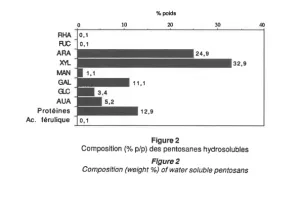
Also called arabinoxylans, xylans or hemicelluloses, these dietary fibers, whose content varies from 2 to 3% depending on the variety, the cultivation of the wheat but also the extraction rate of the mill, have a water absorption capacity four times higher than gluten as well as viscous or gelling properties that will bring stability to the dough, throughout the bread-making process and into the finished product. (3.)
Their role is therefore decisive in the capacity to hold the gas and to obtain the desired volume and texture.
The types of pentosan and their proportions can be measured by chromatography with an HPLC.

Illustration Catherine Renard et al. 1990
Water
The second ingredient in bread, the proportion of water that will be added to the flour is preponderant in the ability to retain gas and in the volume gain.
As we have seen previously, each component will absorb or bind to a specific amount of water, all of this water is called by the baker hydration rate and will be calculated as a percentage of the weight of the flour to simplify calculations in production.
For example, you can hydrate a grissini dough at 52%, a baguette at 68% and a ciabatta at 83% to obtain the ideal consistency for each manufacturing process but also for the desired texture qualities.
Be careful, a lack of water compared to the optimum will not allow a good connection of the network and will slow down enzymatic and fermentative activities, while an excess will weaken the bonds, cause stickiness and let fermentation gases escape.
Optimal hydration can be evaluated with a Brabender Farinograph or a Chopin Mixolab as well as by an analytical bread-making process that will identify the effect of variations at each stage of the manufacturing process.
Kneading
The mechanical work of the kneading machine will bind the components together and develop the network through regular, continuous or discontinuous movements of stretching, folding and cutting the dough.
The energy intensity applied will create bonds, oxidation reactions and heating that will be proportional to the speed and duration of kneading.
The shape of the tool(s), the vat, their movement, their speed and the duration of this work will give the dough specific properties that depend on the type of product desired and the process chosen to make it.
Gluten proteins stretch, oxidize, and bind together to form an increasingly regular, elastic, and fine network. Their ability to develop will depend on their quantities but especially on their qualities.
Air inclusion during kneading will form microcells that will develop during fermentation and baking under the pressure of the gas produced by the yeasts.
The temperature will also have an effect on the bonds and on oxidation, a dough that is too cold will have difficulty forming and a dough that is too hot will release water, we will often look for dough between 22 and 28°C at the end of kneading.
The manufacturing stages
Each step will have an impact on the holding capacity and on the final volume.
- Division and rounding, more or less tightly, it gives elasticity to the dough and can be followed by a rest period to avoid excess tension that could tear the surface of the dough.
- Shaping, it gives the desired shape to the product and above all prepares the dough to withstand the final stages.
- During the final fermentation or proofing, the pressure of the gases expands the cells and stretches the network of proteins and pentosans.
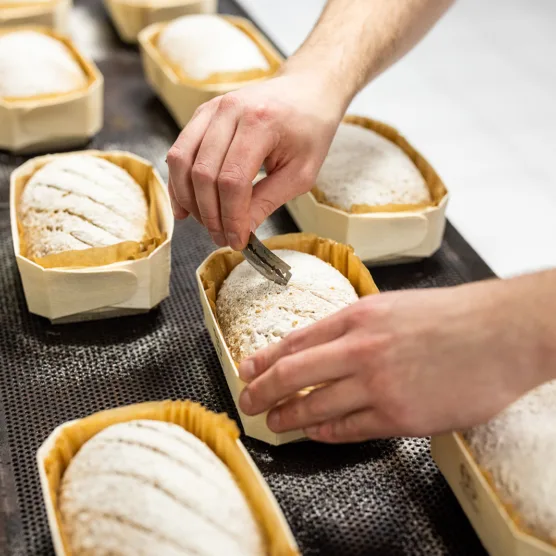
- When placed in the oven, the displacement of the products can cause sagging, for some products scarification will be carried out, creating a weak point on the surface that offers optimal product development and a more attractive appearance.
- Baking, the development in the oven depends on each product: weak for a sandwich bread, strong for a baguette, the structure must therefore be able to support it until it is stabilized by the coagulation of proteins and the gelatinization of starch.

In conclusion
When a loaf lacks volume, the problem isn’t always fermentation.
In many cases, gases are well produced but insufficiently retained. The professional must then analyze the entire system: flour quality, hydration, kneading, fermentation management and dough handling.
Behind each well-developed loaf of bread there is a complex mechanism where every detail counts.
Remember this simple rule:
Final Volume = Gas Production × Gas Holding Capacity
The more these two levers are mastered, the more the regularity and quality of the products are there.
References :