Ensuring bread volume through fermentation control
This is the most common question in the baking industry!
Ensuring the desired bread volume for each type of baked good or Vienese pastry with precision and consistency.
Two factors ensure this volume: fermentation control and gas retention capacity.
The purpose of this first article is to share with you the key points for understanding the fermentation factor.
A second article will be dedicated to gas retention.
The key role of fermentation
To begin with, the consumption of sugars by Saccharomyces cerevisiae yeast results in several byproducts: carbon dioxide, ethanol, aromatic compounds, and heat.
Yeast begins its activity as soon as kneading starts and ceases during baking. The gas produced expands the air pockets created by the mechanical action of kneading (1.), and this pressure causes the dough to rise.
Next, the optional steps of folding, rounding, rolling, or shaping expel some of the gas, reducing the saturation of gas and alcohol in the dough and renewing the yeast’s contact with the sugars.
Then, optimal fermentation is reached at the time of baking; this depends on the desired development during baking—for example, a baguette may be placed in the oven at 60% and a loaf of sandwich bread at 85% of its total fermentation capacity.
Finally, during baking, the yeast remains highly active until it dies at 65°C (2.), after which the expansion of gases completes the development until protein coagulation and starch gelatinization occur around 80°C.
The flour’s ability to feed the yeast
Wheat flours contain a small amount of simple sugars, which feed the yeast at the start of fermentation, and a large amount of complex sugars in the form of long glucose chains called amylose and amylopectin.
These chains make up the starch granules, a small portion of which are damaged during milling, allowing for their hydrolysis—a process in which they are broken down into simple sugars by enzymes naturally present in the grain or added by the miller or baker.
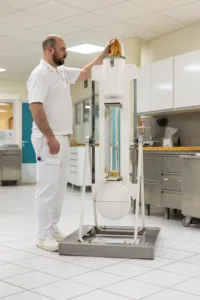
Native enzymatic capacity of your flours can vary greatly and can be precisely assessed in a laboratory (3.) to determine whether it exactly matches the fermentation process being carried out and the volume of the desired final product.
The required enzymatic qualities will therefore not be the same, for example, for refrigerated rolled pizza dough, a hamburger bun made in “no time dough,” or a traditional panettone made over three days with sourdough.
Choosing the yeast
There are yeasts suited to the main recipe variations, particularly the addition of significant amounts of sugars, which generate what is known as “osmotic” pressure on the yeast, and in some cases the use of preservatives that can reduce fermentation activity by 70% if the yeast is not appropriate.
You will also find yeast strains that act more slowly or more quickly, depending on the desired fermentation speed and the residual development desired when the dough is placed in the oven.
Baking process parameters
Finally, two kneading parameters will significantly impact the final volume: hydration and temperature.
In an underhydrated dough, enzyme activity will be slowed and the yeast will be under excessive pressure; conversely, if the dough is overhydrated, the ingredients will be too diluted and the yeast will be in a state known as hypotonic, which will also ultimately slow its activity.
Enzymes and yeast naturally have an optimal temperature that varies for each type of recipe and process; for example, a 2°C difference can result in a 30% loss of volume in a small bread roll.
How to assess the level of fermentation
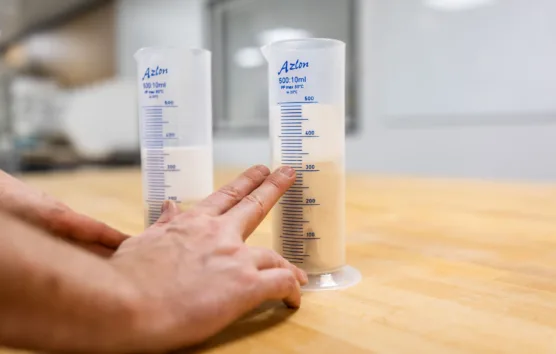
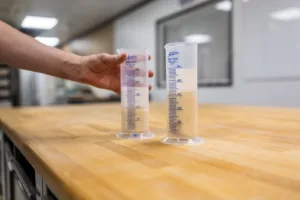
In addition to laboratory analyses, standardized baking tests allow for the identification of an optimal fermentation level through the use of a proofing gauge, the evaluation of proofing tolerance by an experienced test baker, and, of course, the measurement of the final product’s volume using a seeds or laser volumeter.
Need to go further?
To define the quality criteria for your flours,
In order to adjust your kneading parameters,
By identifying the role of enzymes.
References: