

back to the list of articles

Observe, smell, taste : key skills to develop for a better understanding of baked goods

In the fields of baking, pastry, and confectionery, we use our senses every day, often without even realizing it. However, knowing how to observe, smell, and taste is not just a matter of intuition: these are genuine professional skills that can be developed and refined.

For R&D, quality control, production, and marketing teams, sensory analysis is a valuable tool. It allows us to break down all of a product’s characteristics in detail, compare multiple products against one another, better identify sensory defects, assess the impact of a new raw material or recipe change, and validate an innovation before it hits the market.

Observe: the product’s visual aspect

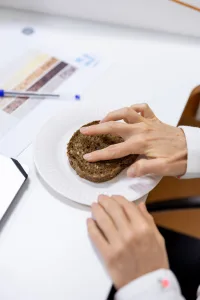
Even before tasting a product, our eyes pick up a great deal of information. This is typically a person’s first interaction with a finished product.

When observing a loaf of bread or a pastry, several criteria can be analyzed :

  • the intensity of the crust’s color and sheen;
  • the product’s volume;
  • the uniformity of the shape;
  • the depth of the slits;
  • the different shades of color in the crumb;
  • the structure and uniformity of the crumb;
  • any defects present.

A trained eye can often identify the first clues to explain a problem. For example, a dense crumb may indicate a problem with fermentation or kneading.
The goal is not merely to observe a result, but to learn how to connect what you see to the various stages of the production process.

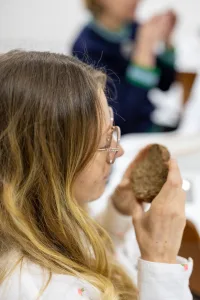
Smelling: Decoding the aromas

After observation comes olfactory analysis.
Bread is a particularly aromatic product. Depending on the ingredients used, the fermentation methods employed, and the baking conditions, it can develop notes that are:

  • sweet
  • toasty
  • fermented
  • plant-based
  • malted.

Taking the time to smell a product helps you better understand its sensory profile.

It’s also an excellent way to detect deviations. A smell that’s too acidic, too fermented, or unusual may indicate an imbalance in the recipe or the production process.
Like any skill, the sense of smell can be trained. The more we enrich our olfactory memory, the easier it becomes to identify and accurately describe what we perceive.


Tasting: analyzing rather than simply enjoying

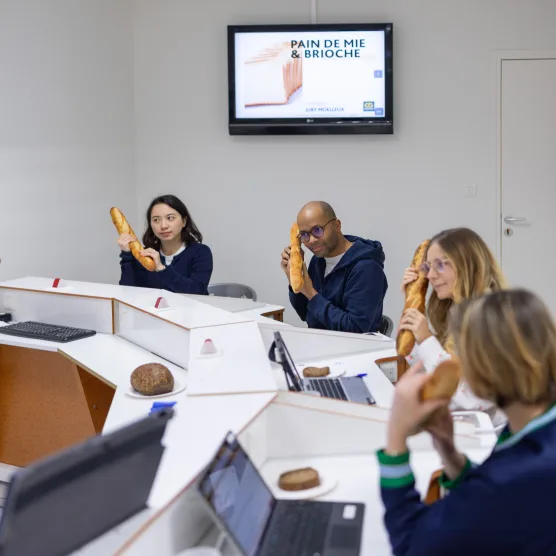
Analyse sensorielle des arômes du pain

Tasting is often associated with a simple question: “Is the product good?”
In an objective sensory analysis, the question is broader: Why is the product liked or disliked?
When tasting a baked good, several elements must be evaluated:

  • aromatic intensity
  • the nature and persistence of the various perceived aromas
  • the flavors
  • the texture of the crust when bitten into and as indicated by the sound it makes
  • the textural sensations of the crumb while chewing.


This analysis allows for an objective comparison of several products and a better understanding of consumer preferences.
For example, two loaves of bread may look similar but offer very different taste experiences. It is often during tasting that these differences become clearly apparent.

Developing a Common Language

One of the challenges of sensory analysis is putting sensations into words.
Saying that a product is “good”, “soft,” “melt-in-your-mouth,” or “pleasant” remains highly subjective.
Conversely, describing a crumb as “ springy ” crumb, a “roasted” note, or a “crisp” crust allows for more precise communication.

Developing this sensory vocabulary facilitates communication between quality, R&D, production, and sales teams.
It then becomes easier to identify areas for improvement and share a common vision of the desired product.

A Skill That Drives Innovation

In a context where consumer expectations are rapidly evolving, sensory skills are becoming increasingly important.
Reducing salt, improving the nutritional profile, incorporating new ingredients, or developing more sustainable products can alter the sensory experience.

Observing, smelling, and tasting allows us to concretely measure the impact of these changes.

These skills also help guide formulation decisions and ensure that innovations meet market expectations.


A word from the expert: 

Naël HAIDAR – Head of Methods and Sensory Studies – EUROGERM France

Understanding baked goods begins with sharing a common language. Indeed, it will always be more difficult to identify a product’s sensory profile, interpret the need for improvement, or demonstrate the sensory impact of a solution if the vocabulary used differs from one person to another. For example, my definition of the word ‘melt-in-the-mouth’ is almost certainly not the same as yours.
My interpretation of your sensory experience—and everything that follows—will therefore be biased from the start. It is therefore essential in our work to train ourselves to speak the ‘sensory language’ more effectively, and Eurogerm Academy can serve as a gateway for you to learn this new ‘foreign language.’”


In the same category, here are some other articles you might find interesting...