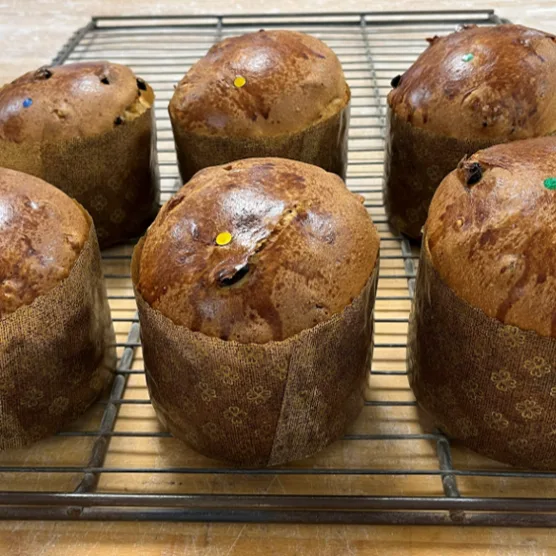
The evolution and secrets of Panettone
With its slender shape, light and airy crumb, and aromas of butter, raisins, and citrus, panettone has become one of the world’s most iconic leavened baked goods. Behind this apparent simplicity, however, lies one of the most complex production processes in modern baking—the result of several centuries of history and an exceptional mastery of natural sourdough.
A birth shrouded in legend
The origins of panettone are difficult to pinpoint with certainty. Historians nevertheless agree that it first appeared in the Milan region between the 15th and 16th centuries. Several accounts coexist today, blending folk traditions and legends.
There are many legends, and the most popular one traces its origins to the court of Ludovico il Moro, Duke of Milan, during a Christmas feast. According to legend, the dessert intended for the guests was accidentally burned by the cook. A young kitchen assistant named Toni is said to have then improvised a recipe using the few ingredients available: flour, butter, eggs, raisins, and citron zest. It was an instant hit. The guests reportedly named this cake “Pane di Toni,” or Toni’s bread, which over time became “panettone.”
Another, more romantic account attributes its origin either to a young Milanese nobleman, Ughetto degli Atellani, or to a falconer, Messer Ulivo, who was in love with a baker’s daughter. To get closer to her, he is said to have taken a job as a baker’s apprentice. He then enriched the shop’s bread with butter, eggs, and candied fruit, thus creating the panettone to win over his beloved.
Finally, a third legend tells that a nun named Ughetta created this brioche, marked with a cross, for her convent’s Christmas celebration.
These legends, which have no historical basis, reflect the people’s attachment to this festive, family-oriented treat. It is also interesting to note that the word “ughett” means “raisin” in the Milanese dialect.
Historical sources, meanwhile, date back to the 15thth century and were linked to a domestic ritual deeply rooted in Milan: the Log Ceremony. On Christmas Eve, families would gather around the hearth, where a huge log of wood was burning. During this gathering, the head of the household would break three large loaves of wheat bread—wheat being a luxury ingredient reserved solely for holidays, whereas rye or millet bread was eaten year-round—and distributed a slice to everyone present. One slice was carefully preserved until February 3, the feast day of “San Biaggio,” to protect against winter respiratory illnesses.
The first written record of the “Panaton de Danedaa” is found in Giovanni Capis’s 1606 Milanese lexicon, which supplements the list detailing the ingredients needed to make the 13 loaves to be offered on Christmas Day, dated 1599. (1.)
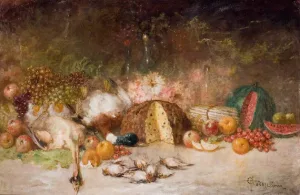
Painting by Giovanni Battista Todeschini (1857–1938)
From Its Milanese origins to the industrial revolution
Long associated with Christmas celebrations in northern Italy, panettone has gradually crossed the borders of the peninsula. In recent years, it has established itself as a trendy bakery and pastry creation, enjoyed well beyond the holiday season and available in numerous gourmet variations.
This popularity stems in large part from its unique character: a rich dough, a long fermentation process, and carefully selected ingredients that give it a light texture despite its high fat content.
The most notable innovation is attributed to Angelo Motta, who, in 1929, transformed this dense, small-sized product into a soft, slender, and airy one through the use of paper molds called “Pirottino” and a significantly optimized recipe.
While panettone has become a symbol of Italian baking excellence, its reputation rests as much on its history as on the extreme complexity of its production. Behind its apparent lightness lies a particularly demanding microbiological and technological balance.
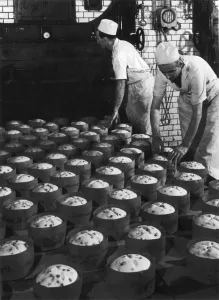
Motta panettones being placed in the oven in 1935 in Milan, Italy
A regulated and demanding product
Traditional panettone cannot be improvised. In Italy, its composition is even governed by a ministerial decree that defines the ingredients and essential steps in its production. Two elements are particularly crucial: butter and natural sourdough starter.
Butter accounts for about a quarter of the product’s total weight. Its quality directly influences the product’s softness, shelf life, and the development of its aromas. As for the sourdough starter, it is the true driving force behind fermentation. Its microbiological balance plays a major role in the crumb’s structure, the aromatic quality, and the excellent preservation of the finished product. (2.)
The sourdough starter: the true heart of panettone
For baking professionals, panettone presents a real technical challenge. Managing the starter requires great precision and solid expertise. Its success depends on constantly monitoring the starter through sight, smell, and taste. A healthy starter should have a pleasantly tangy aroma, an ivory color, and a uniform, honeycomb-like structure.
As with many fermented products, the final quality is the result of a subtle balance between yeasts, lactic acid bacteria, temperature, time, and the regularity of refreshments.
Over the course of the refreshments, the culture conditions naturally select the yeasts and lactic acid bacteria best adapted to the environment. The nature of the flour, hydration, temperature, and frequency of refreshments gradually shape a microbial consortium capable of tolerating both the acidity of the sourdough and the high sugar content of the panettone dough.
Recent research has identified species of lactic acid bacteria in panettone sourdoughs that are particularly well-suited to sugar-rich environments, notably Lactobacillus sanfranciscensis, Fructilactobacillus fructivorans, and Limosilactobacillus fermentum. Their balance with the yeasts directly contributes to fermentation stability and the sensory characteristics of the final product.
Professionals use various starter culture management techniques to ensure the quality of the fermentation and the finished product; the best-known are:
- The “Legato,” a very firm sourdough starter wrapped in string, which constricts the dough so that the yeasts develop resistance to osmotic pressure and to promote a ratio of lactic acid to acetic acid that is more favorable to sensory quality as well as to the starter’s fermentative strength.
- The “Bagnetto,” which is this same firm sourdough starter; after maturation, it is cut into slices and soaked in lukewarm water several times to extract much of the acetic acidity that could harm the yeast and the sensory qualities of the panettone.
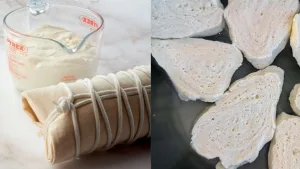
Lievito legato and bagnetto
An exceptional production process
Often considered one of the most challenging brioche-style pastries to master, due to its richness and lightness, the production of panettone involves precise and delicate steps.
- Preparing the starter or “Lievito madre” takes 7 to 10 days when starting with flour and about 5 days when starting with a traditional sourdough starter for crusty bread. This adaptation is necessary to withstand osmotic pressure (created by sugars), ensure proper gas production, and maintain a pH between 4 and 4.7. (3.)
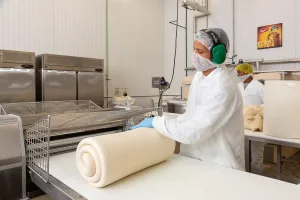
Sourdough preparation at Bauducco, Extrema, Brazil
- The first dough, “l’impasto,” is made by adding flour, egg yolk, sugar, and butter to the sourdough starter; it ferments overnight until it triples in volume.
- The second dough, “il secondo impasto,” is further fed with flour, egg yolk, and sugar, and then the final ingredients are added: butter, dried and candied fruits, flavorings, spices, honey, and liqueurs, depending on the variation chosen by the baker.
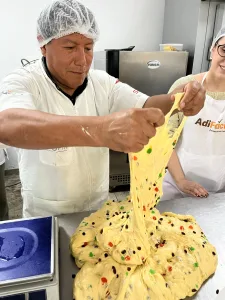
Dough extensibility at Eurogerm Andina, Nova Lima, Peru
- Shaping, or “formatura,” can be done immediately or after a one-hour rest; the dough must be shaped carefully, without any flour or fat that could cause cracks at the base of the product. The dough ball is placed in a circular paper mold and, optionally, covered with a cracker paste.
- Fermentation is a long and delicate process; the temperature will depend on the consortium of yeasts and bacteria that will work in concert with the flour–sugar–egg substrate; this fermentation activity relies on the close interaction between yeasts and lactic acid bacteria, whose metabolic processes complement each other to produce carbon dioxide, aromas, and balanced acidity. Certain lactic acid bacteria can also produce exopolysaccharides, including dextrans, which contribute to water retention, crumb stability, and the soft texture.
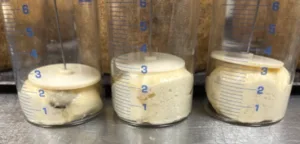
Measurement of panettone fermentation at Eurogerm France, Saint Apollinaire
- Baking, or “cottura,” is an extremely delicate process that lasts nearly an hour at a low temperature and aims to permanently stabilize the product’s structure through starch gelatinization and the denaturation of gluten and egg proteins without drying out the product. The analysis of baking curves using probes and simulations conducted with Chopin’s Mixolab make it possible to identify the ideal relationship between recipe parameters and baking parameters. (4.)
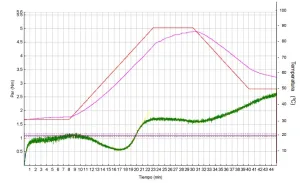
Evaluation of gelatinization, stability, and retrogradation at Eurogerm Andina
- Cooling is performed “capovolto”—suspended upside down—to cool and solidify the product while preventing it from collapsing. This process can take several hours depending on the panettone’s size, density, and filling.
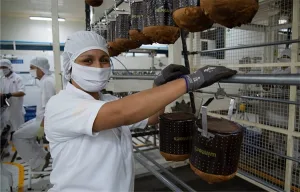
Cooling of panettone at Compañia Nacional de Chocolates, Lima, Peru
Key figures for panettone production
| Parameter | Typical value |
| Yeast starter preparation time | 5 to 10 days |
| Total fermentation time | 30 to 48 hours |
| Fat content | 20 to 28% |
| Fermentation temperature | 26–30°C |
| pH of the starter culture | 4.0 to 4.7 |
| Cooling with the head down | 8 to 12 hours |
A source of inspiration for today’s bakers
Panettone is often called “the Everest of fermentation.” This reputation is well-deserved. Few products present so many technical challenges: a demanding natural sourdough starter, an extremely rich dough, long fermentation times, and a process where every detail matters.
Yet it is precisely this complexity that fascinates bakers and pastry chefs around the world. Every successful panettone is a testimony not only to technical mastery but also to a living heritage passed down from generation to generation. In an industry constantly seeking authenticity and differentiation, it remains one of the finest expressions of baking craftsmanship.
Sources:
- *Varon Milanes de la lengua de Milan, e Prissian de Milan de la parnonzia milanesa*, 1606, by Giovanni Capis and Giovanni Ambrogio Biffi.
- Italian regulations: https://www.gazzettaufficiale.it/eli/id/2005/08/01/05A07670/sg
- Giambattista Montanari, Omnia Fermenta. Technology of Sourdough Dough.
- Cristian Luna, Evaluation of Panettone Parameters and Solutions. Eurogerm Andina.